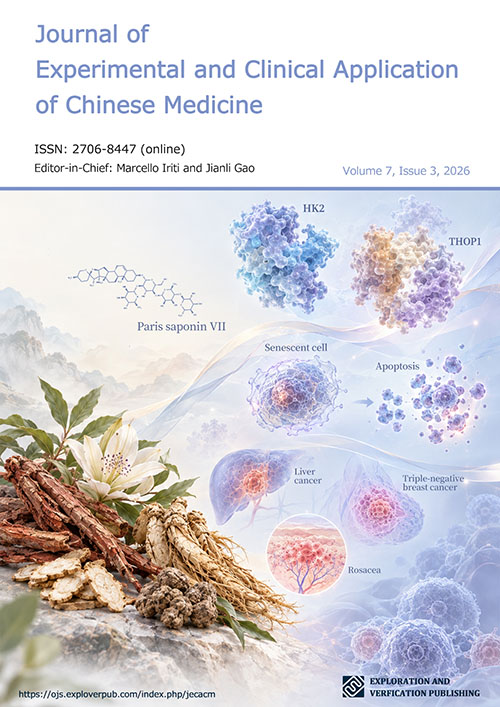
Polyphyllin VII inhibits triple-negative breast cancer via THOP1 modulation
DOI:
https://doi.org/10.62767/Keywords:
polyphyllin VII, TNBC, apoptosis, THOP1Abstract
Objective: We assessed the role of polyphyllin VII in triple-negative breast cancer (TNBC) and investigated the potential molecular mechanism. Methods: Cellular proliferation was measured using the CCK-8 assay. To evaluate colony formation and cell migration, we conducted colony formation assays and transwell analyses. Apoptotic protein levels were determined through Western blot. The in vivo anti-TNBC efficacy of polyphyllin VII were evaluated using xenograft tumor models. Results: Polyphyllin VII exhibited inhibitory effects on cellular proliferation, colony formation, migration, and also induced apoptosis. Polyphyllin VII downregulated THOP1 expression in TNBC. THOP1 overexpression noticeably reversed the aforementioned effects of polyphyllin VII. In vivo, polyphyllin VII demonstrated inhibition of TNBC tumor growth and THOP1 expression, while simultaneously upregulating cleaved caspase 3. Conclusion: These results demonstrated that polyphyllin VII induced apoptosis by regulating THOP1 in TNBC. THOP1 is therefore proposed as a potential novel target of polyphyllin VII for combating TNBC.
References
Siegel RL, Miller KD, Wagle NS, et al. Cancer statistics, 2023. CA: A Cancer Journal for Clinicians 2023; 73 (1): 17–48.
Vagia E, Mahalingam D, Cristofanilli M. The landscape of targeted therapies in TNBC. Cancers 2020; 12 (4).
Lan T, Lu Y, Luo H, et al. The role of chemotherapy in patients with T1bN0M0 triple-negative breast cancer: A real-world competing risk analysis. Journal of Cancer 2021; 12 (1): 10–17.
Zhang C, Jia X, Wang K, et al. Polyphyllin VII induces an autophagic cell death by activation of the JNK pathway and inhibition of PI3K/AKT/mTOR pathway in HepG2 cells. PLOS One 2016; 11 (1): e0147405.
Hsieh MJ, Chien SY, Lin JT, et al. Polyphyllin G induces apoptosis and autophagy cell death in human oral cancer cells. Phytomedicine: International Journal of Phytotherapy and Phytopharmacology 2016; 23 (13): 1545–1554.
Chen JC, Hsieh MJ, Chen CJ, et al. Polyphyllin G induce apoptosis and autophagy in human nasopharyngeal cancer cells by modulation of AKT and mitogen-activated protein kinase pathways in vitro and in vivo. Oncotarget 2016; 7 (43): 70276–70289.
Lin Z, Liu Y, Li F, et al. Anti-lung cancer effects of polyphyllin VI and VII potentially correlate with apoptosis in vitro and in vivo. Phytotherapy Research: PTR 2015; 29 (10): 1568–1576.
Ahmad B, Rehman SU, Azizullah A, et al. Molecular mechanisms of anticancer activities of polyphyllin VII. Chemical Biology & Drug Design 2021; 97 (4): 914–929.
Du SG, Zhang HM, Ji YX, et al. Polyphyllin VII promotes apoptosis in breast cancer by inhibiting MAPK/ERK signaling pathway through downregulation of SOS1. The American Journal of Chinese Medicine 2024; 52 (3): 885–904.
Yang Q, Guo J, Zheng J, et al. Polyphyllin VII protects from breast cancer-induced osteolysis by suppressing osteoclastogenesis via c-Fos/NFATc1 signaling. International Immunopharmacology 2023; 120: 110316.
Hanahan D, Weinberg RA. Hallmarks of cancer: The next generation. Cell 2011; 144 (5): 646–674.
Fuchs Y, Steller H. Programmed cell death in animal development and disease. Cell 2011; 147 (4): 742–758.
Fulda S. Tumor resistance to apoptosis. International Journal of Cancer 2009; 124 (3): 511–515.
Plati J, Bucur O, Khosravi-Far R. Dysregulation of apoptotic signaling in cancer: Molecular mechanisms and therapeutic opportunities. Journal of Cellular Biochemistry 2008; 104 (4): 1124–1149.
Pistritto G, Trisciuoglio D, Ceci C, et al. Apoptosis as anticancer mechanism: Function and dysfunction of its modulators and targeted therapeutic strategies. Aging 2016; 8 (4): 603–619.
Kroemer G, Galluzzi L, Brenner C. Mitochondrial membrane permeabilization in cell death. Physiological Reviews 2007; 87 (1): 99–163.
Brentnall M, Rodriguez-Menocal L, De Guevara RL, et al. Caspase-9, caspase-3 and caspase-7 have distinct roles during intrinsic apoptosis. BMC Cell Biology 2013; 14: 32.
Degterev A, Boyce M, Yuan J. A decade of caspases. Oncogene 2003; 22 (53): 8543–8567.
Boatright KM, Salvesen GS. Mechanisms of caspase activation. Current Opinion in Cell Biology 2003; 15 (6): 725–731.
McKie N, Dando PM, Rawlings ND, et al. Thimet oligopeptidase: Similarity to'soluble angiotensin II-binding protein' and some corrections to the published amino acid sequence of the rat testis enzyme. The Biochemical Journal 1993; 295 (1): 57–60.
Krause DR, Piva TJ, Brown SB, et al. Characterization and localization of mitochondrial oligopeptidase (MOP) (EC 3.4.24.16) activity in the human cervical adenocarcinoma cell line HeLa. Journal of Cellular Biochemistry 1997; 66 (3): 297–308.
Gewehr MCF, Teixeira AAS, Santos BAC, et al. The relevance of thimet oligopeptidase in the regulation of energy metabolism and diet-induced obesity. Biomolecules 2020; 10 (2).
Oliveira V, Campos M, Hemerly JP, et al. Selective neurotensin-derived internally quenched fluorogenic substrates for neurolysin (EC 3.4.24.16): Comparison with thimet oligopeptidase (EC 3.4.24.15) and neprilysin (EC 3.4.24.11). Analytical Biochemistry 2001; 292 (2): 257–265.
Hok AHYS, Bolsewig K, Ruiters DN, et al. Thimet oligopeptidase as a potential CSF biomarker for Alzheimer's disease: A cross-platform validation study. Alzheimer's & Dementia 2023; 15 (3): e12456.
Santos NBD, Franco RD, Camarini R, et al. Thimet oligopeptidase (EC 3.4.24.15) key functions suggested by knockout mice phenotype characterization. Biomolecules 2019; 9 (8).
Sundstrom JM, Hernandez C, Weber SR, et al. Proteomic analysis of early diabetic retinopathy reveals mediators of neurodegenerative brain diseases. Investigative Ophthalmology & Visual Science 2018; 59 (6): 2264–2274.
Qi L, Li SH, Si LB, et al. Expression of THOP1 and its relationship to prognosis in non-small cell lung cancer. PLOS One 2014; 9 (9): e106665.
Nomoto S, Hishida M, Inokawa Y, et al. Expression analysis of THOP1 in background liver, a prognostic predictive factor in hepatocellular carcinoma, extracted by multiarray analysis. Annals of Surgical Oncology 2014; 21 Suppl 3: S443–450.
Paschoalin T, Carmona AK, Rodrigues EG, et al. Characterization of thimet oligopeptidase and neurolysin activities in B16F10-Nex2 tumor cells and their involvement in angiogenesis and tumor growth. Molecular Cancer 2007; 6: 44.
González-Turén F, Lobos-González L, Riquelme-Herrera A, et al. Kinin receptors B1 and B2 mediate breast cancer cell migration and invasion by activating the FAK-Src axis. International Journal of Molecular Sciences 2024; 25 (21): 11709.
Downloads
Published
Data Availability Statement
The data presented in this study are available on request from the corresponding author.
Issue
Section
License
Copyright (c) 2026 The Author(s)

This work is licensed under a Creative Commons Attribution 4.0 International License.